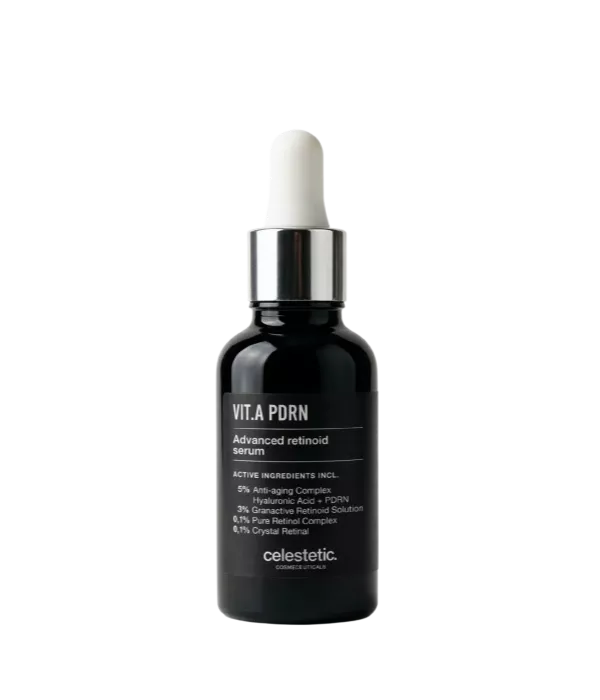
Complexe anti-âge acide hyaluronique + PDRN

Ce complexe associe l’acide hyaluronique, hydratant biomimétique essentiel, au PDRN, un actif régénérant issu de la biotechnologie. Ensemble, ils améliorent l’hydratation, stimulent la réparation cellulaire et soutiennent la fermeté, pour une peau visiblement plus lisse, rebondie et résistante au vieillissement.

Acide hyaluronique : hydratation profonde et soutien de la barrière

L’acide hyaluronique (AH) est une molécule naturellement présente dans la peau où elle retient jusqu’à 1 000 fois son poids en eau. Il améliore :
  • L’hydratation de l’épiderme
  • La souplesse
  • La réduction des ridules de déshydratation
  • La fonction barrière

Sources scientifiques :

  1. Papakonstantinou, E., Roth, M., & Karakiulakis, G. (2025). Hyaluronic Acid and Skin: Its Role in Aging and Wound-Healing Processes. Gels, 11(4), 281. Lien.
  2. Draelos, Z. D. (2021). Efficacy evaluation of a topical hyaluronic acid serum in facial photoaging: A prospective clinical study. Dermatology and Therapy, 11, 1235–1244. Lien.
  3. Liguori, A., & Rinaldi, M. (2024). Influence of molecular weight on the bioactivity of topical hyaluronic acid. Current Research in Cosmetic Science, 3(1), 45–57. Lien.

PDRN : réparation cellulaire, inflammation réduite et régénération

Le PDRN (PolyDéoxyRiboNucléotide) est un polymère extrait par biotechnologie qui active les récepteurs A2A impliqués dans la réparation tissulaire. De nombreuses études montrent qu’il :

  • Accélère la régénération cellulaire
  • Améliore l’élasticité de la peau
  • Réduit l’inflammation
  • Stimule la synthèse de collagène
  • Améliore la cicatrisation et la qualité globale de la peau
Sources scientifiques :
  1. Kim, Y. H., Lee, J.-H., & Park, J.-H. (2023). Polydeoxyribonucleotide as emerging therapeutics for skin diseases. Applied Sciences, 15(19), 10437. Lien.
  2. Mortezaee, K., & Djalali, M. (2025). Polydeoxyribonucleotide in skincare and cosmetics: Mechanisms and clinical outcomes. Journal of Skin & Stem Cell, 9(1), Article e159728. Lien.
  3. Galeano, M., Bitto, A., Altavilla, D., et al. (2023). Development and characterization of polydeoxyribonucleotide wound-healing therapy. International Journal of Biological Macromolecules, 244, 125345. Lien.
  4. Raftery, R. M., O’Brien, F. J., & Cryan, S.-A. (2020). Adenosine A2A receptor–mediated mechanisms of polydeoxyribonucleotide in tissue repair. International Journal of Molecular Sciences, 21(23), 6098. Lien.
  5. Zhang, H., & Lu, S. (2024). Clinical perspectives on polydeoxyribonucleotide therapy in dermatology: A systematic review. European Journal of Plastic Surgery, 47(2), 155–166. Lien.

Une synergie anti-âge puissante

En combinant un hydratant biomimétique (AH) et un actif régénérant (PDRN), ce complexe :
 
  • Repulpe la peau
  • Améliore l’élasticité
  • Diminue les rides
  • Renforce la barrière cutanée
  • Accélère la récupération après stress cutané (froid, UV, exfoliations…)
  • Apporte un éclat plus uniforme

C’est un duo particulièrement performant pour les peaux matures, déshydratées ou ternes.

Sources scientifiques :
  1. Kim, J. H., Lee, K. T., Park, J. H., Kim, D. Y., Kim, S. Y., & Kim, B. J. (2019). Polydeoxyribonucleotide combined with hyaluronic acid accelerates wound healing through enhanced angiogenesis and fibroblast activity. Polymers, 11(10), 1635. Lien.
  2. Falaschi, P., Giordano, N., Santucci, A., Galeazzi, M., & Marcolongo, R. (2020). Nanostructured hyaluronic acid improves PDRN bioavailability and enhances tissue repair mechanisms. Nanomaterials, 10(9), 1801. Lien.
  3. Centurione, L., Antonucci, I., Lattanzi, W., D’Angelo, M., Centurione, M. A., & Sancilio, S. (2018). Polydeoxyribonucleotide promotes extracellular matrix production and cell proliferation in dermal fibroblasts. International Journal of Molecular Sciences, 19(7), 2050. Lien.

Nos produits contenant cet actif

sérum anti-âge avancé.
120,00€